A delicate touch of silver brings the entire Celtic Kiwi design to life.

|
(Click on picture to enlarge)
|
I originally started to carve pendants in bone - as the unique texture lends itself to detailed carving designs that are both beautiful and highly tactile in nature.
All the following pieces are made from reclaimed bone that has been cleaned naturally, in-ground, over a period of years.

|
“Trinity”
This carving reflects my Yorkshire heritage and the three points of this Celtic design represent the natural elements of earth, air, and water.
It was also originally thought to symbolise life, death, and rebirth before the Celts adopted Christianity in the 4th century AD and thereafter, with the Father, the Son, and the Holy Spirit (or Holy Ghost).
The centre stones are turquoise on silver
Needless to say it has also now been adopted by my wife Sandy.
(Beef Bone, turquoise, silver) (Click on picture to enlarge)
|

|
“Strider”
Like other water-dwelling creatures, the octopus represents purity, creativity and deep psychic emotions,
as well as its more obvious traits of intellect, grace and flexibility. The fishbone clasp that joins the braided cord together is one I desgined to complement the nautical theme.
(Beef Bone )
(Click on picture to enlarge)
|

|
“Fantail Pendant”
This pendant was claimed by my wife, Sandy, when it first started to take shape. Now fully complete, it captures the grace and elegance of this acrobatic bird in flight. It later became the inspiration for the silver fantail collection.
(Beef Bone )
(Click on picture to enlarge)
|

|
“Butterfly Pendant”
The idea of using interlocking butterfly wings to create a longer pendant, for myself, came to me while watching a couple of monarch butterflies fluttering around the swan plants in our garden. However, it also seems to have been adopted by my wife, Sandy and I think I’m beginning to spot a trend.
(Click on picture to enlarge)
|

|
“Seahorse Pendant”
This pendant was carved as a gift for my mum, Betty.
As a child, I gave my mum a clay seahorse that I made at school. It still hangs on her wall at home, so 50 years later it was only fitting to make her another.
(Beef Bone )
(Click on picture to enlarge)
|

|
“A is for Alison”
The design of this piece uses the shape of two leaping dolphins to form the letter A. It was carved as a gift for my sister, Alison.
The braided black cord has been incorperated into the overall design to create a natural space between the two animals as well as being functional.
(Beef Bone )
(Click on picture to enlarge)
|

|
“Feather Touch”
Inspired after finding a feather in the garden, I wanted to see just how thin I could carve bone and still maintain enough strength for a pendant.
(Beef Bone )
(Click on picture to enlarge)
|
Carving pendants in deer antler. Unlike bone, antlers have a higher volume of collagen, and this fibrous protein gives them the flexibility and strength to bend slightly and absorb massive impacts. Using antler, I have been able to make a thinner piece than would be possible using more brittle mediums like bone.

|
“The Monarch”
This piece was designed to capture the delicacy of a monarch butterfly.
(Deer Antler)
|
This is currently my only venture into deer antler carving. If you look closely, you can also see my take on The Vitruvian Man. (Click on picture to enlarge)
Made from a second individually carved wax model and CAD drawing, the piece shown below was sent to an Auckland foundry for my only casting in brass.

|
“Ellie in brass”
At 14.15g, the weight still adds quality, and the darker texture of the metal helps accentuate its fine detail.
(Brass - Copper/Zinc alloy)
(Click on picture to enlarge)
|
Design and Composition
The unique textures of a background are integral to the overall design of an artwork. The original painting shown below is called 'Hidden Gem' by Stewart Wright and uses acrylic and plaster medium on paper to create the illusion of movement and depth of a forest. The painting is one that I entered in a local event called the 100 x 100 exhibition, the name being representative of both the number of artists exhibiting and the dimensions of each work in centimetres.

|
“Hidden Gem”
An abstract creation inspired by walks in the bush that surrounds our property in the Bay of Islands
(4“ x 4“ Acrylic and Plaster Medium on Paper)
(Click on picture to enlarge)
|

|
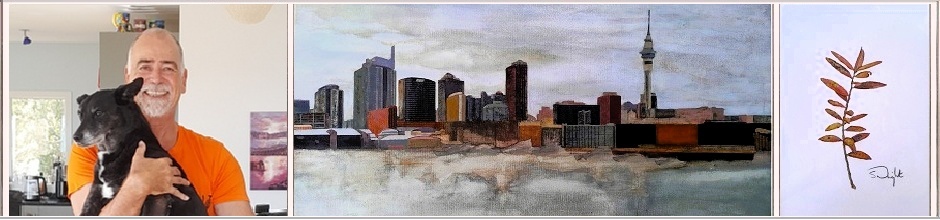
“Cityscape”
Inspired by the classic film “Brigadoon”, this cityscape of Auckland Harbour mixes fine and minimalist detail to create an ethereal effect that allows the viewer to create their own story.
(15“ x 30“ Acrylic on canvas)
(Click on picture to enlarge)
|

|
“Something Special”
An abstract impression of the sunrise views from our balcony.
Waikare Inlet, Opua.
(12“ x 16“ Acrylic and plaster medium on canvas)
(Click on picture to enlarge)
|

|
“Autumn Kauri”
This painting of a Kauri twig from our garden captures the diversity of nature's palette found in a simple leaf. It was also featured in one of the 100 x 100 exhibitions.
(4“ x 4“ Acrylic and watercolor on paper)
(Click on picture to enlarge)
|

|
“Circuitree”
Inspiration for these pieces came from a broken clock. The first is a collage of the mechanical parts, and the second is an acrylic painting that was entered into this year's 100 x 100 exhibition.
(4“ x 4“ Acrylic on paper)
(Click on picture to enlarge)
|